
Related Course
- 35 mins
Skoolie Toilet Options
The one course you need to help you decide which skoolie toilet is right for your desired skoolie lifestyle.
More people than ever are ditching traditional homes and choosing to live in converted school buses, AKA, skoolies. So what is a skoolie? With the rising costs of housing and the shift we’ve seen towards minimalism and sustainable living, skoolies have become a way of life sometimes optional, sometimes necessity. There are many people who are attracted to skoolies, from empty nesters to 20-something young adventurers (like us)!
If you’re wondering why so many people are doing it, what exactly a skoolie is, and why so many people actually choose to live in skoolies, read on.
What Is a Skoolie Exactly?
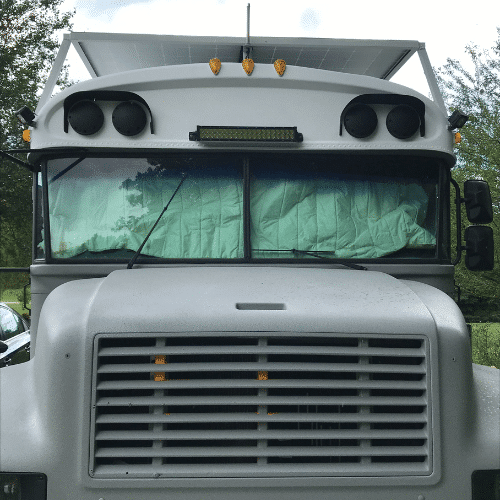
A skoolie is a decommissioned school bus that has been transformed into a custom motorhome or tiny house on wheels. It’s built out with all of the necessary facilities such as a kitchen, a bathroom, a sleeping area, and a couch/gathering space. Skoolies are usually self-sustainable with options like fresh and gray water holding tanks, an off-grid battery bank, solar panels, composting toilets, and much more. Unlike RVs or RV vans, skoolies offer a blank canvas with solid bones, allowing for complete uniqueness and personalized touches from the exterior to the interior.
While vanlife tends to focus on compact, stealthy builds and RVs often come with pre-set layouts, skoolies fall somewhere in between—offering the robustness and square footage of an RV with the creativeness of a DIY van build. Historically, skoolies were first adopted out of the 1960s counterculture with people seeking freedom and non-conformity.
Why Do People Choose Skoolies?

Before we can answer this question, we need to ask ourselves why do people choose houses, why do people choose apartments, why do people choose RVs, why do people choose vans, etc. In comparison to these questions, skoolies represent a gateway to a lifestyle filled with freedom and possibility. Unlike RVs or pre-built tiny homes, a skoolie allows you full creative control and it gives you a sense of pride when you turn one thing that’s meant to transport, usually children, from point A to point B and you create into a home.
Another reason people choose skoolies is the financial aspect. While the cost of a traditional home, RV, van, or tiny house can easily soar into six figures, a DIY skoolie conversion often lands in the much more manageable $20,000 to $40,000 range, albeit out of pocket. For those willing to problem solve and get a little dirty, the cost of living savings is such a benefit. Take the average monthly mortgage payment of $2,200/month in 2024. If you spend $30,000 on your bus, you’ll have saved that in a mortgage in 13 months.
Beyond the cost savings, skoolies are suited for off-grid, eco-conscious living, and for people looking to reduce their carbon footprint. With the installation of solar panels and composting toilets to create a self-sufficient home on wheels.
Most importantly, a skoolie offers a sense of adventure in the something that you built yourself (if you choose the DIY route). Travel where you want (with a few restrictions skoolie owners need to be aware of), when you want, and live a more simple life.
Sizes of School Buses Used for Skoolie Conversions
There are three main sizes of school buses that are used in conversions: full-size, mid-size, and short buses. Full-size buses are usually 35 to 45 feet in length and offer maximum square footage. They are great for large families or those looking to create a spacious and luxurious rolling home. You can easily add bunk beds for children in these larger buses. One downside of full size buses will be driving a larger vehicle and you may not be able to go into some national parks depending on the length of your rig. Check national parks you’d like to visit in your skoolie before making this decision.
Mid-size buses, generally between 25 to 35 feet, is a great in between size that strike a balance between maneuverability and living space. We see a lot of couples (like us!) or small families (1, maybe 2 children) gravitate towards this option, because it provides enough room for all of the amenities without being cumbersome to drive.
Short buses, or “shorties,” range from 20 to 25 feet in length, very similar to van sizing. Shortie skoolies are easier to park and can sometimes fit in a parking space, making them a go-to for solo travelers or couples prioritizing adventure over space. Sometimes we wish we would have gone with a shortie, although we like the space of a mid-size for full-time living. Keep in mind you may have to give up some things here with a shortie, such as an interior shower depending on the layout you choose.
Each bus size comes with its own set of pros and cons so it’s a good idea to weigh these out for yourself and/or family before committing to a size.
What’s Involved In a Skoolie Conversion?

There’s so much that’s involved in a skoolie conversion process! You are building your house, after all. It all begins with purchasing the right bus. Ideally, you want a bus that is mechanically sound, free from significant rust, and within your budget, typically falling between $4,000 to $10,000.
Once you purchase your bus, the first step is demoing the entire bus, like the above picture. This includes removing the seats, old flooring, wall and ceiling paneling, and existing insulation. Basically stripping it down to bare bones so you can start the build process. Insulating the bus is the next step, along with putting up the plywood walls.
After that, you can design your floor plan! Although we iterated our floor plan so many times, I’m sure other people do as well! Make sure you have space for all of the amenities you’d like in your skoolie as each choice will affect how you use your space. Read our full guide to skoolie floor plans here. Once your floor plan is locked, you can start the framing process, but make sure to do rough electrical and plumbing before this.
You’ll also want to think about your solar setup and battery options and placements for these. Once framing is done, you can start building out your skoolie!
Throughout the process, think about safety considerations like proper weight distribution, emergency exits, and fire prevention systems.
How Much Does a Skoolie Cost?

Budgeting for a skoolie conversion involves several layers. From the raw bus to demo of the bus to the build out to the solar setup to the investment needed for proper tools for the build out, expenses can add up quickly.
There are other hidden expenses, so make sure you think about this as well. Make sure to budget for maintenance and have a mechanic take a look at your bus before you go out and travel. It wouldn’t be much fun to be on your first trip in your skoolie only to have it breakdown because you didn’t take it in before setting our on your adventure.
It’s a good idea to overestimate your budget to account for unexpected expenses. Check out our full DIY skoolie conversion cost guide here.
Legalities & Regulations
Most states require that you re-title your bus as a motorhome after (or during) conversion. This process often involves having law enforcement come out to see your skoolie, proving that it includes sleeping quarters, a kitchen, correct plumbing, that your school bus is no longer yellow, and all items indicating it once was a skoolie are removed, such as the stop sign and the lettering on the bus.
Once your skoolie is now a motorhome, insurance can then be a struggle, as not all carriers are willing to cover custom conversions. Read our complete insurance guide.
Finally, parking laws and zoning restrictions vary widely. Some campgrounds won’t let skoolies in, which is why skoolies are generally build for off-grid purposes as BLM land is a very popular option where skoolies park while adventuring.
Off-Grid Living With a Skoolie
One of the most appealing aspects of skoolie life is the potential for true off-grid independence because you are building them from scratch. You don’t have the option to customize your off-grid setup when purchasing an RV. What you see is what you get with RVs. Many skoolies are built with robust solar systems paired with lithium battery banks, unlike RVs.
Fresh water tanks are commonly sized to 100 gallons or more offering weeks of fresh water. Composting toilets are very common, no need to waste management solution.
Pros & Cons of Skoolie Life

Pros
- Finances – Building your own skoolie is often far less expensive than purchasing a traditional home or RV. Also you own your home. You don’t have a bank to pay a monthly payment to. You actually own it.
- Customization – Anything you need or want, you can have.
- Sustainability – Skoolies are very eco friendly, from off-grid water systems to composting toilets to solar power, by living in a bus you are lowering your environmental footprint.
- Freedom – As the saying goes, home is where you park it.
- Strong sense of community – Since skoolies are so unique (and a ton of work), there’s just a connection when you meet someone else who is doing the same thing.
Cons
- Limited space – This can be challenging if you’re converting with a significant other and you haven’t had to live minimally before.
- Constant problem solving – The lights in the front of the bus are working, but the lights in the back of the bus aren’t. I open the faucet but no water is flowing, yet the water pump is on. The list could go on and on, owning a skoolie you have to be able to problem solve and fix those problems otherwise you could be out of water or light.
- Not having a place to call “home” – Meaning if your backyard is changing all of the time, you don’t have a consistent place to go grocery shopping, get a haircut, have that favorite restaurant you turn to all the time.
Is Skoolie Life Right for You?
We’ve given you a lot of information on what is a skoolie, now you have to decide if it’s right for you. Do you see yourself getting dirty, learning new things, and essentially building a house from scratch? Building a skoolie is a big undertaking and not for the faint hearted. Remember, you can purchase a finished skoolie and just hit the open road if that’s what’s calling you versus spending time on a bus build, but you will still have to problem solve.
Another point to consider is that you have to be comfortable with downsizing and living minimally. This comes super easy to some and very hard to others. It forces you to prioritize what’s truly important, paring down belongings and living within a confined space. For those who are seeking a strong sense of community, most people will find it through the skoolie networks and meetups!
However, it’s not for everyone and that’s okay! If you prefer stability, dislike the thought of regular mechanical upkeep, or feel uneasy with the unpredictability of life on the road, you may not like a skoolie. The key is to weigh your priorities. Do you crave freedom and flexibility more than you value predictability and convenience?
Popular Skoolie Layout Ideas & Inspiration

When it comes to designing a skoolie interior, the possibilities are endless, limited only by the size of your bus and your imagination. You’ll want to be considerate of who you’ll be sharing your skoolie with whether it be a significant other, your children, or pets and make sure to include spaces dedicated just for them. If your significant other works at home, a desk/office will be necessary. If you have a dog, consider adding in a special place for them to be able to look out the window and consider where you are going to put them when driving.
If you’ll be living in with 2+ kids, consider a separate bathroom with a shower by itself and a toilet/sink area by itself. Also be sure to build some bunk beds for the kids.
Also consider multi-purpose furniture. Our TV used to store away so we can have a desk during the day and pull the TV out at night. Added things like this can make your skoolie super functional.
Resources for Aspiring Skoolie Owners
When we converted our skoolie in 2018, the resources were slim. We started this website, at first to document our journey, but it quickly flipped to helping other people build out their skoolies. So feel free to browse around and reach out to us if you need help with anything regarding your build or skoolie! There are other communities as well, like the skoolie subreddit and various Facebook groups offer a space to connect with other skoolie owners. YouTube is another channel where you’ll find a lot of skoolie content. If you’re looking to purchase a raw bus or finished conversion, check out our skoolie classifieds.
Final Thoughts on What Is a Skoolie
Skoolies offer an unmatched sense of freedom and creativity, blending the thrill of the open road with the satisfaction of building your own home. Whether you’re looking to do weekend getaways or full-time off-grid living, is converting a school bus the adventure you’re looking for?
What Is a Skoolie FAQ
Can you legally live in a skoolie full time?
Yes, though zoning laws and parking regulations vary by region.
How long does a skoolie conversion take?
Anywhere from 6 months to 2+ years depending on scope, how much time you can dedicate to work on it, and experience.
Is a skoolie safe for families with kids?
Absolutely! Many skoolies are designed with bunks and child-friendly layouts.
How do you find places to park overnight?
Popular options include BLM land, RV parks, truck stops, and apps like iOverlander.

Join the Skoolie Livin Community!
The post What Is a Skoolie? The Ultimate Guide to School Bus Conversions (2025) appeared first on Skoolie Livin | School Bus Conversion Community, Guides, & Classifieds.
Source link [faqly_accordion id=”113″]